
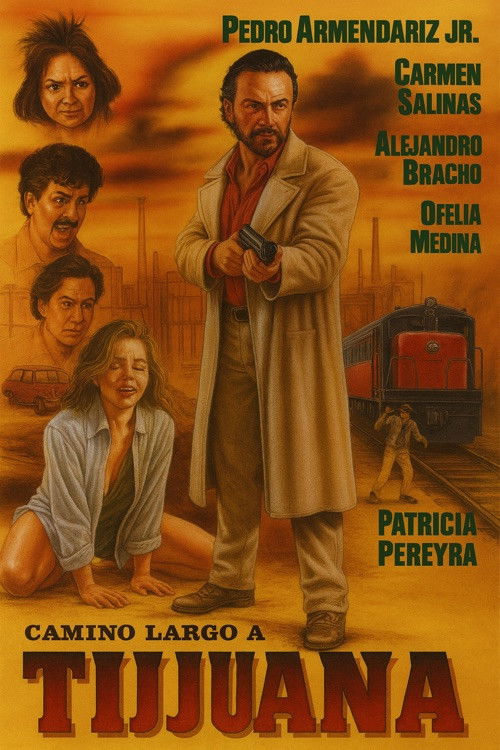
Camino largo a Tijuana(1991)
About Camino largo a Tijuana
Juan (Armendariz) lives in a trash depository in Mexico City. He knows Lila (Pereyra), a drug addict rich girl who reminds him of his long lost daughter. Lila is kidnapped by drug dealers and Juan feels responsible for her. He takes the long way to Tijuana to rescue Lila. (Written by Maximiliano Maza mmaza@campus.mty.itesm.mx)
Before Luis Estrada became a household name for his biting political satires that define modern Mexican cinema, he crafted this gritty, atmospheric journey through the underbelly of society. Camino largo a Tijuana serves as a fascinating time capsule of early nineties filmmaking, capturing a raw, unpolished energy that contrasts sharply with the slicker productions often seen in contemporary global cinema. The story centers on Juan, a man scraping by in the margins of Mexico City, whose quiet life is punctured by a sudden, desperate mission. By pairing a disenfranchised scavenger with a privileged young woman caught in a dangerous web of narcotics, the film builds a compelling dynamic that bridges the gap between disparate social classes. It is a character study disguised as a rescue mission, focusing more on the psychological toll of the road than on conventional action beats.
The narrative trajectory acts as a bridge between the classic road movie format and a poignant exploration of displacement. For fans of Indian regional cinema who appreciate the grounded, character-driven storytelling found in the best of Malayalam or Tamil independent dramas, this film offers a similar sense of lived-in authenticity. It avoids the glossy veneer of mainstream entertainment, opting instead for a somber look at how personal grief and systemic societal neglect intersect. The performances, particularly from the seasoned cast, ground the more frantic elements of the plot in a reality that feels both heavy and remarkably human. It is a film for those who prefer their stories to simmer with tension rather than explode with spectacle, rewarding patient viewers with a deep dive into the motivations of a protagonist who has nothing left to lose.
While Estrada would later move toward grander spectacles, this early entry reveals the roots of his obsession with the fractured state of his home country. The film functions as a stark reminder that even a simple search for a missing person can become a profound reckoning with one's own past. By placing his protagonist on an arduous route toward the border, the director emphasizes the physical and metaphorical weight of the journey itself. It is a quintessential piece for anyone interested in the evolution of Latin American film, providing a stark, honest look at the lives of those who usually remain invisible in urban landscapes. Whether you are a student of international noir or simply a fan of intense, slow-burn narratives, this piece of history remains a compelling watch that resonates long after the final frame.