About Electrical Girl
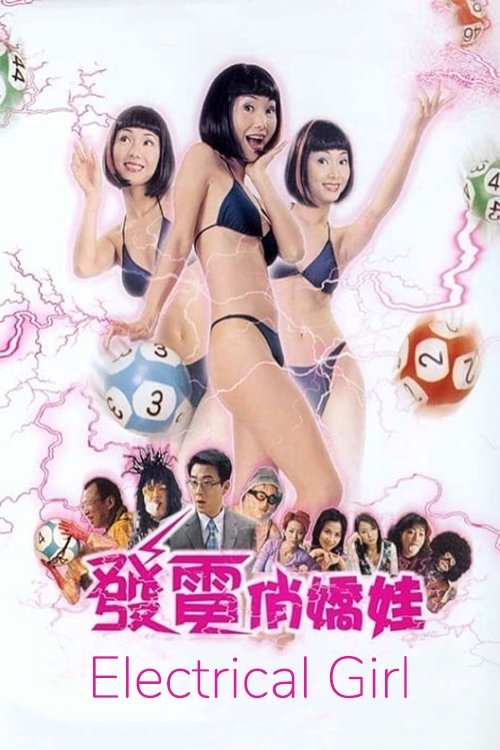
Centers around a horny young woman who has electrical genitals. When young Jan gets sexually aroused, she emits bolts of electricity from various orifices. Any unfortunate males in the vicinity of her nude form invariably end up singed and smoky, and that’s if they’re lucky. It also seems that Jan sees visions of lottery balls as she climaxes. In order to have a premonition of all six lottery balls, Jan sets out to find a lover who can really rock her world.
Electrical Girl remains a curious artifact of early millennium Hong Kong cinema, blending the region's penchant for bawdy slapstick with an imaginative, albeit eccentric, sci-fi premise. Directed by Bowie Lau Bo-Yin, the film leans heavily into the absurdity characteristic of its era, placing a supernatural condition at the center of a romantic comedy framework. The narrative revolves around a protagonist whose intimate arousal triggers powerful static discharges, a device that serves both as a catalyst for chaotic physical humor and a bizarre commentary on the perils of modern dating. While contemporary audiences might find the film's reliance on high-concept absurdity dated, it occupies a distinct niche in the landscape of Cantonese genre-bending features that thrived on pushing boundaries through irreverent, low-budget storytelling.
The film distinguishes itself by weaving a supernatural lottery-related subplot into its adult-oriented comedy, creating a strange intersection between greed and romance. By linking the heroine’s climactic energy surges to financial fortune, the story transforms a standard pursuit of intimacy into a high-stakes quest for the winning numbers. This approach reflects a broader trend in Hong Kong cinema of the time, where speculative elements were frequently used as comedic crutches to inject energy into otherwise conventional romantic pairings. For viewers who appreciate the unpolished and wild sensibilities of the 2000s Hong Kong film industry, this project offers a nostalgic look at a period when filmmakers felt emboldened to experiment with truly outlandish concepts that blurred the lines between fantasy and farce.
Those who enjoy cult cinema or mid-budget regional comedies featuring ensemble casts will find much to parse here. The film benefits from the presence of veteran performers like Benz Hui Siu-Hung and Lee Siu-Kay, whose recognizable screen presence grounds the more frantic sequences. The production is clearly tailored for an audience that enjoys the specific brand of irreverent humor found in Cantonese comedies of that decade, where physical gags often take precedence over subtle character development. While it does not aim for thematic depth, the movie stands as a testament to a specific moment in regional entertainment history where the fusion of bedroom comedy and sci-fi tropes was not just possible, but actively pursued. It serves as an intriguing watch for anyone interested in the experimental fringes of the Hong Kong film circuit during a time of significant transition for the local industry.
Cast(12)