Magnolia(1999)
“Things fall down. People look up. And when it rains, it pours.”
About Magnolia
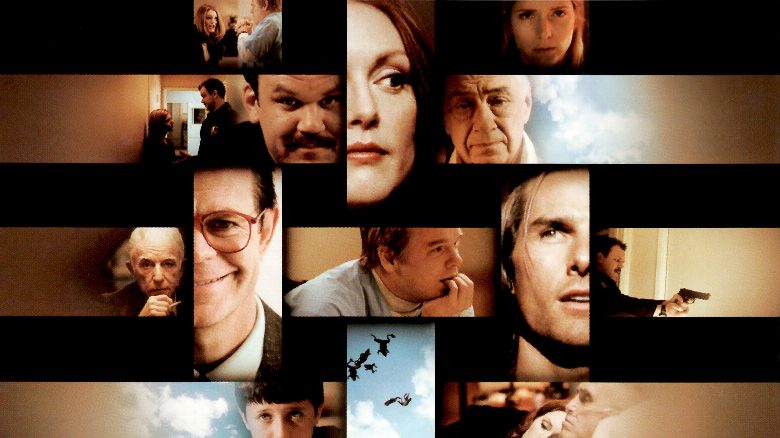
On one random day in the San Fernando Valley, a dying father, a young wife, a male caretaker, a famous lost son, a police officer in love, a boy genius, an ex-boy genius, a game show host and an estranged daughter will each become part of a dazzling multiplicity of plots, but one story.
Paul Thomas Anderson created a cinematic tapestry in Magnolia that remains a towering achievement of ensemble storytelling, weaving together disparate lives across the San Fernando Valley with an intensity that few modern dramas have managed to replicate. While Indian cinema often thrives on the grandeur of sprawling multi-generational epics, this film offers a Western parallel in its ambition, connecting a collection of fractured souls through a single, transformative day. The narrative structure feels remarkably modern even decades later, as it balances the weight of regret, the burden of past mistakes, and the desperate search for redemption. It stands as a masterful study of coincidence and connection, where the lives of a game show host, a weary police officer, and a prodigy navigating his own brilliance eventually collide in ways that feel both inevitable and startlingly raw.
For audiences accustomed to the emotional depth found in the best of Malayalam or Tamil character-driven dramas, Magnolia offers a similar commitment to internal landscapes. It does not rely on traditional action but instead leans heavily on the quiet power of its performers to convey deep-seated trauma. The film is perfectly suited for viewers who appreciate non-linear storytelling that prioritizes psychological authenticity over plot mechanics. It demands patience and attention, rewarding those who are willing to sit with the vulnerability of characters who are reaching their breaking points. The film functions as a mirror for the human condition, exploring how individual choices ripple outward to affect people who are ostensibly strangers, yet are all tethered by the same fundamental need for forgiveness.
This project serves as a definitive showcase for the directorial prowess of Paul Thomas Anderson, who solidified his reputation here as an auteur capable of managing heavy thematic lifting while maintaining a cohesive vision. His ability to draw out career-best performances from an ensemble cast is the engine that keeps the three-hour runtime feeling essential rather than indulgent. By eschewing the typical polished aesthetic of 1990s Hollywood, the film feels grounded and tactile, capturing the grit of the valley alongside the ethereal quality of its central mystery. It is a work that challenges its audience to look past the surface of daily routines and confront the deeper, often hidden currents that govern our lives. Whether you are a fan of sprawling narrative experiments or simply appreciate cinema that refuses to provide easy answers, this remains an essential viewing experience that continues to resonate with viewers who seek complexity and profound emotional honesty in their film choices.
Cast(71)