About Mare's Nest
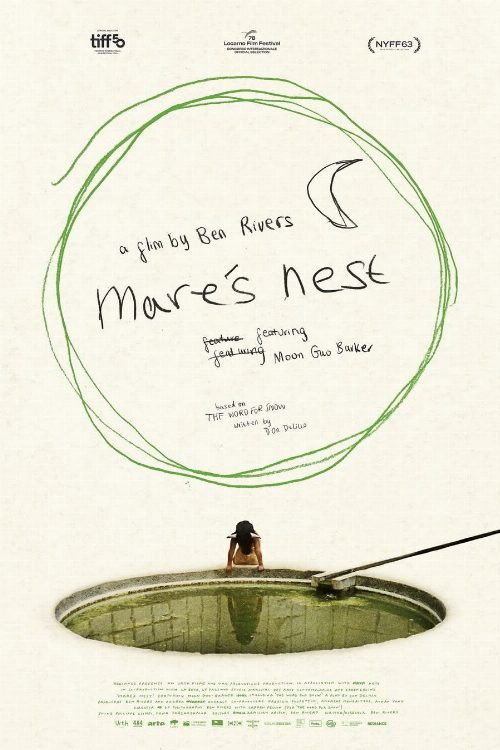
Moon travels through a mysterious unexplained world free of adults. Moon meets a scholar turned sage and her translator in a mountain hut, where she tries to understand what is happening, based on a play by Don DeLillo. She meets many others who perform for her, show her a film, give her gifts, show her different possibilities for living. She observes and moves on into an unknown future.
Director Ben Rivers has carved a singular path through contemporary cinema, often blurring the lines between documentary observation and surrealist fiction, and his 2026 feature Mare's Nest continues this fascination with liminal spaces. Moving away from the high-stakes spectacle typical of modern science fiction, the film presents an eerie, introspective journey into a landscape devoid of an older generation. By drawing inspiration from the elliptical prose of Don DeLillo, Rivers constructs a meditative environment where the protagonist, played by Moon Guo Barker, navigates a series of enigmatic encounters. It is a work that feels less like a traditional narrative and more like a captured dream, inviting the audience to step into a reality that functions by its own strange, internal logic.
The film serves as a compelling departure for viewers accustomed to the rigid world-building of mainstream genre entries, particularly as international audiences increasingly seek out experimental voices that challenge conventional storytelling. While the Indian film landscape—from the emotional depth of Malayalam cinema to the grand spectacle of Telugu productions—has recently seen a surge in high-concept speculative fiction, Mare's Nest offers a different texture entirely. It prioritizes atmosphere and philosophical inquiry over plot-driven momentum, echoing the slow-burn intensity found in some of the most daring independent projects coming out of the global South today. The presence of a scholar and her translator within a secluded mountain hut acts as a pivot point, grounding the abstract nature of the film in a search for meaning and communication.
Those who appreciate cinema that demands active participation will find much to dissect here. The episodic nature of the protagonist's journey, which involves witnessing performances and receiving symbolic gifts, positions the film as a tapestry of human possibility. By stripping away the authority figures that usually define a coming-of-age arc, Rivers forces us to consider how we might construct our own identities when detached from the past. It is an ideal recommendation for fans of speculative art-house projects who prefer cerebral engagement over explosive action. As Barker moves through this world, the film asks us to contemplate the weight of the unknown, making it a standout entry for those who value evocative visuals and a haunting, lingering narrative style that refuses to offer easy answers or predictable resolutions.
Cast(10)