About Play House
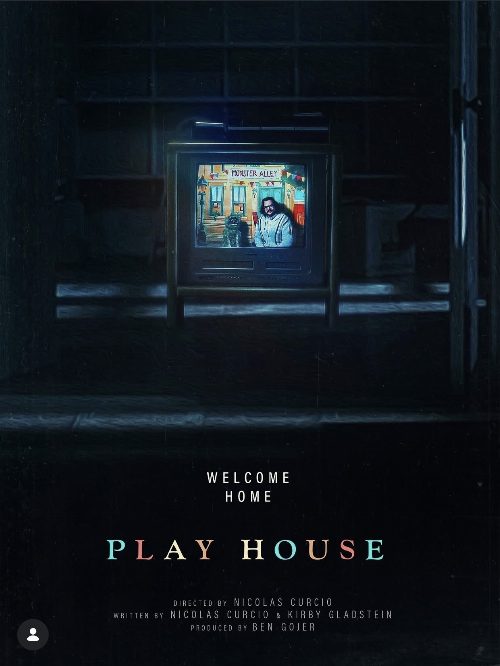
While renovating a dilapidated house to win back his ex, a young man discovers VHS tapes of an unaired children’s show in the basement. As he watches, the show’s disturbing origins begin to unravel his life. Winner of Fantastic Fest’s Inaugural "Fantastic Pitches" Competition
The intersection of domestic restoration and psychological dread serves as the primary engine for Play House, a 2026 horror entry that manages to turn the mundane task of home improvement into a chilling descent. Directed by Nicolas Curcio, the film taps into the modern fascination with found footage and analog media, utilizing the grainy aesthetic of forgotten broadcast television to unsettle the audience. By centering the narrative on a protagonist attempting to repair his personal life alongside his physical environment, the film explores how the ghosts of the past often manifest in the items we choose to keep. It is a premise that feels both intimate and expansive, moving beyond standard haunted house tropes to examine the psychological weight of media consumption and the dangers of obsession.
For fans of international cinema who have grown accustomed to the high production values and atmospheric storytelling of contemporary Indian horror, Play House offers a different kind of tension. While the Telugu and Malayalam industries have recently excelled at blending folklore with visceral scares, this film leans into a Western tradition of eerie, surrealist horror that focuses on the corruption of innocence. Curcio, whose work on this project gained significant industry attention during its development phase, demonstrates a keen understanding of how to build unease through silence and visual decay rather than constant noise. The cast, featuring Will Harrison and Jessica Sula, provides a grounded anchor for a story that quickly threatens to spiral into hallucinatory territory, making the stakes feel genuinely personal rather than merely supernatural.
This project is positioned as a must-watch for those who appreciate slow-burn narratives where the environment itself acts as a primary antagonist. Viewers who enjoy films that challenge their perception of reality will likely find the interplay between the protagonist and the mysterious VHS tapes particularly compelling. Because the story avoids the usual jump-scare reliance of mainstream horror, it invites the audience to participate in piecing together the protagonist’s unraveling psyche. As the boundaries between the children’s show and the actual world begin to blur, the film forces a confrontation with the idea that some secrets are better left undisturbed in the dark. It is a sophisticated addition to the horror landscape of 2026, serving as a reminder that the most terrifying stories are often those that hide in plain sight, waiting for the right person to press play.