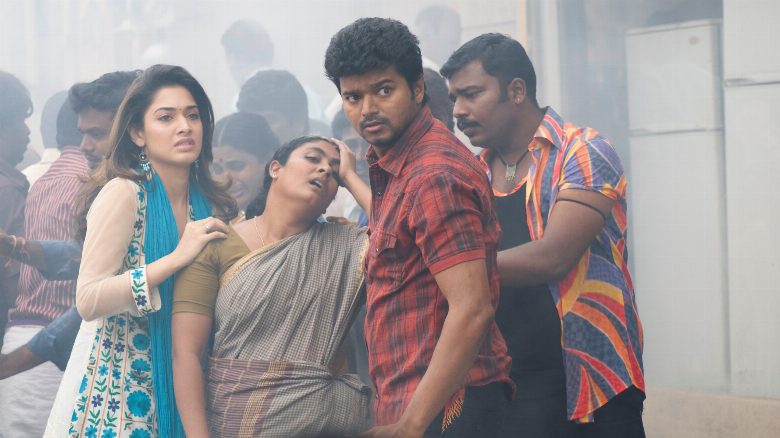

Sura(2010)
About Sura
When a corrupt politician tries to seize the land of his villagers, a brave and powerful fisherman sets out to fight against him.
The coastal landscape of Tamil cinema has long served as a canvas for larger than life heroism, and Sura stands as a definitive entry in the pantheon of big budget spectacles that defined the turn of the decade. Released in 2010, the film places Vijay at the helm of a high stakes narrative that leans heavily into the mass entertainer template. By casting the superstar as a local fisherman whose primary concern is the welfare of his seaside community, the production taps into the enduring appeal of the protector archetype. The conflict centers on a predatory political figure attempting to dispossess the residents of their ancestral ground, a premise that effectively channels the populist energy characteristic of the era. The inclusion of seasoned comedian Vadivelu provides a vital rhythmic balance to the intense confrontations, ensuring that the heavy themes of displacement and injustice are punctuated by lighthearted moments that fans of the genre have come to expect.
From a cultural perspective, Sura reflects the industry's focus on regional power dynamics and the moral authority of the common man. It operates within the classic framework of a David versus Goliath struggle, where the protagonist acts as both a protector of tradition and a force of nature against institutional corruption. The chemistry between Vijay and Tamannaah Bhatia serves as the emotional anchor, grounding the more stylized action sequences in a relatable romantic arc. For viewers who appreciate the evolution of Tamil commercial cinema, this movie represents a notable phase in the career of a lead actor who was steadily refining his ability to balance intense physical stunts with charismatic screen presence. It is a film that leans into its own artifice, prioritizing energy and spectacle over subtle realism, which remains a hallmark of high octane South Indian cinema.
This project is best suited for audiences who enjoy the high energy atmosphere of classic masala films where the stakes are always personal and the resolution is rarely quiet. It caters to those who value the star power of established icons and the nostalgic charm of a decade that prioritized grand theatrical experiences. Even with the passage of time, the film remains a point of interest for followers of the genre who want to examine the trajectory of mainstream storytelling. Whether it is the rhythmic choreography of the musical numbers or the heightened drama of the face offs between the hero and the antagonist, the production remains a quintessential example of how regional industries utilize popular motifs to engage massive fanbases. It stands as a vibrant, if uncompromising, look at how the Tamil film industry crafts its mythologies.