
About Born to Fake
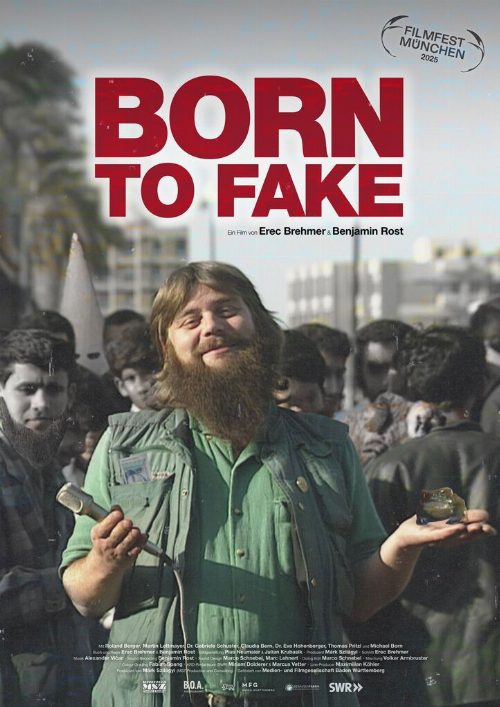
In 1996, one of the biggest media scandals in German history shook the public: Michael Born, a self-made journalist, had faked over twenty reports for the newly established private television station between 1990 and 1996. Some seemed amateurish, others dealt with absurd topics: child labor for IKEA in India, drug addicts licking toads to get high, and the Ku Klux Klan in the Eifel region were just some of his numerous fabrications. How did it come to this? Was Michael Born an enlightened figure who subversively exposed the tabloid system, a victim of the system, or simply a bumbling fraud? Film traces Michael Born's footsteps. Put together from hundreds of hours of raw material and the memories of former companions, an incredible story of forgery emerges. A media-theoretical film about levels of reality, fake news, and the question: Why do we actually believe what we see?
The landscape of modern media is built upon a foundation of trust that has been eroded by decades of sensationalism, a phenomenon that finds its most provocative origin story in the bizarre career of Michael Born. Director Erec Brehmer revisits the nineties with Born to Fake, a documentary that dissects how a single individual managed to hoodwink the German public by manufacturing reality for television consumption. This is not merely a historical recount of a fraudster but a sophisticated examination of the psychological hunger for the extraordinary. By digging through vast archives of raw footage and gathering testimonies from those who operated within his orbit, the film forces viewers to confront the uncomfortable truth that audiences often prefer a compelling lie over a mundane reality.
For followers of global cinema, particularly those who appreciate the recent surge in investigative documentaries coming out of the Indian film industries, this project serves as a chilling mirror to the current era of misinformation. While Indian cinema has recently explored the dark side of digital influence and viral fame, Born to Fake grounds these contemporary anxieties in a tangible, analog past. It highlights the systemic failures of private broadcast journalism during a period of rapid industry expansion, effectively portraying Born as a mirror reflecting the moral decay of the newsrooms that employed him. The narrative poses a relentless question about the nature of our shared reality, suggesting that the drive for ratings has always been the primary catalyst for the blurring of truth.
This documentary is an essential watch for cinephiles who are fascinated by the intersection of ethics and entertainment. It avoids the trap of simple hero worship or villainization, instead presenting a complex portrait of a man who exploited the gaps between objective fact and narrative desire. Those interested in media theory or the evolution of the tabloid culture will find the film particularly gripping, as it dissects the mechanics of deception with surgical precision. By focusing on the memories of those who worked alongside Born, the film captures the surreal atmosphere of a decade defined by technological transition and moral ambiguity. It is a cautionary tale that feels incredibly relevant today, reminding us that our reliance on visual evidence has always been our most vulnerable point, leaving us to wonder how many more fabrications remain hidden in the blind spots of history.
Cast(5)

Crew
Director
Producer
Director of Photography
Music
Similar Films