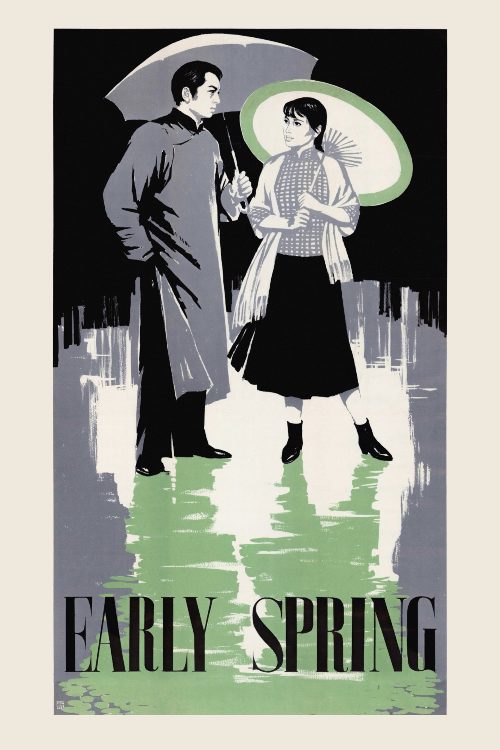
Early Spring(1963)
About Early Spring
An idealistic youth moves to the countryside in search of a purer, more honest society, but finds injustice even in his remote village.
Yasujiro Ozu remains a titan of world cinema, yet Early Spring from 1963 offers a fascinating departure from his typical domestic focus, shifting the lens toward the weary corridors of corporate life and the quiet desperation of the Japanese white-collar worker. While many of the director's most celebrated works revolve around the generational tensions within a single household, this film captures the stifling atmosphere of a modernizing Tokyo, where the promise of postwar stability often masks a profound sense of spiritual drift. It functions as a somber meditation on the transition from youthful ambition to the mechanical demands of adulthood, highlighting the specific cultural malaise that defined the era of rapid economic recovery in Japan.
The narrative centers on a young man navigating the monotony of his professional routine, a premise that feels strikingly contemporary despite the film being over six decades old. By focusing on the interplay between workplace obligations and the yearning for personal fulfillment, the film explores the fragility of marriage when confronted with the crushing weight of societal expectations. It eschews the dramatic excess often found in romantic dramas, opting instead for a restrained, observational style that forces the audience to confront the quiet tragedies of everyday existence. The cast delivers performances of remarkable interiority, capturing the subtle shifts in emotion that occur behind the masks of polite social interaction.
Viewers who appreciate the deliberate pacing of Asian cinema or those interested in the evolution of the workplace drama will find much to admire here. It is a quintessential piece for students of film history, serving as a bridge between the classic era of Japanese studio filmmaking and the more introspective, character-driven works that would follow. Fans of the director will recognize his signature aesthetic choices—the low camera angles and the impeccable framing of domestic spaces—yet they may be surprised by the film's cynical edge regarding the corporate machine. For those seeking an immersive look at the human cost of progress, this story remains a compelling, if melancholic, reflection on the search for meaning in a rapidly changing world. It stands as a testament to the fact that while technology and urban landscapes may shift, the fundamental struggle to reconcile one's desires with the rigid structures of society remains a timeless cinematic preoccupation.