Erotik auf der Schulbank(1968)
About Erotik auf der Schulbank
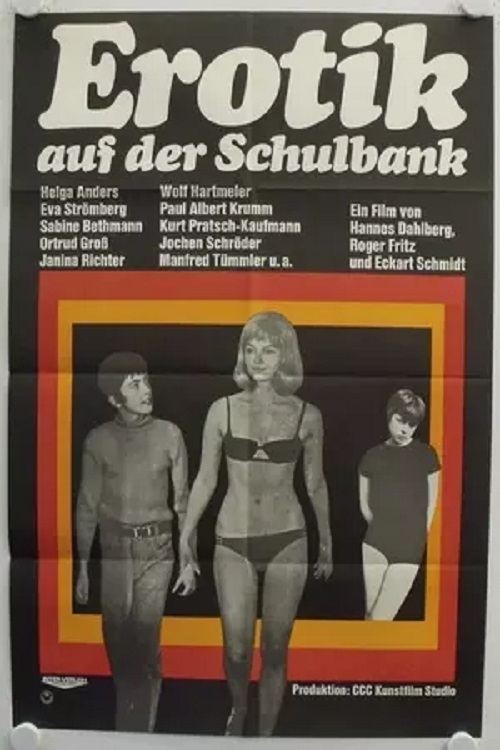
Three episodes depict events that actually took place in the years before the film was made. Three true‐life dramas explore teacher–student taboos: 1. Monika: A young teacher’s love for his pregnant 17‐year‐old student leads to his self‐incrimination amid legal peril. 2. Sybille: A 15‐year‐old fabricates a scandalous affair with her bachelor principal, ending in his suicide. 3. Fantasie: A 13‐year‐old boy’s infatuation with his teacher drives him to violence and a troubled return to reality.
Eckhart Schmidt took a bold and provocative look at the fragility of academic boundaries in his 1968 feature Erotik auf der Schulbank, a film that remains a fascinating time capsule of late sixties European social tension. By framing his narrative as a triptych of stories rooted in actual events, the director moves away from mere sensationalism to examine the psychological fallout of forbidden intimacy between educators and those they are meant to guide. While modern Indian cinema often explores the high-pressure environment of student life through the lens of competitive academic achievement or coming-of-age rebellion, this German drama operates in a darker, more cautionary space. It captures a specific moment in history when the rigid moral codes of the mid-century were beginning to fracture under the weight of burgeoning youth liberation and institutional scrutiny.
The film is structured into three distinct segments, each dissecting the catastrophic consequences of blurring professional lines. Whether it involves a young man entangled with a pregnant teenager, a malicious fabrication that destroys a principal, or the dangerous obsession of a young boy, the movie maintains a clinical yet harrowing perspective on how power dynamics collapse. For audiences accustomed to the vibrant, often melodramatic storytelling of contemporary Tollywood or Bollywood, this film offers a starkly different viewing experience. It lacks the musical interludes or grand emotional crescendos typical of global Indian cinema, favoring instead a grounded, almost austere approach to character study that prioritizes the gravity of its subject matter over stylistic flair.
Viewers who appreciate European arthouse cinema from the sixties will find this work particularly compelling for its unflinching gaze at societal taboos. It is less a celebration of romance and more a bleak sociological experiment, inviting the audience to consider the irreversible ripples of personal choices within a structured environment. Schmidt utilizes this anthology format to show that no matter the age or the specific circumstances, the fallout of these illicit connections is invariably tragic. It is a piece of cinema that demands a patient viewer, one interested in the historical evolution of the teacher-student trope on screen. By stripping away the glamour often associated with such narratives in today's media, the film forces an uncomfortable but necessary confrontation with the ethical failures of its protagonists. It serves as a stark reminder that even in a changing cultural landscape, some transgressions carry a weight that transcends time and geography.
Cast(14)