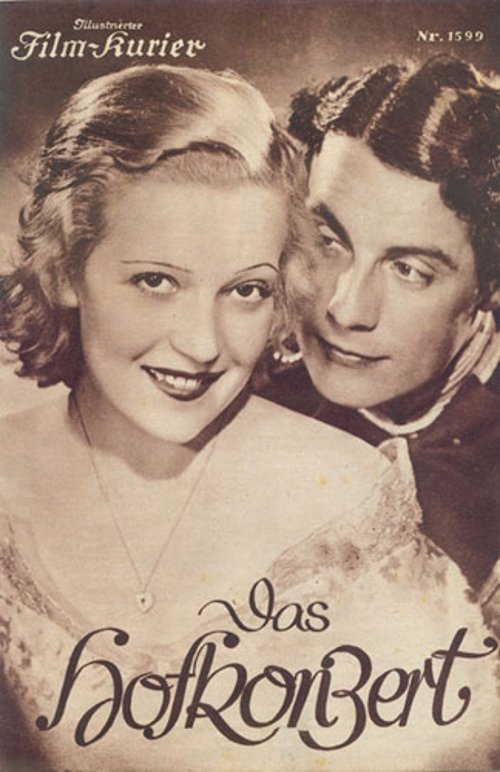
The Court Concert(1936)
About The Court Concert
Before he became cult director Douglas Sirk, Detlef Sierck cut his teeth on such lavish European star vehicles as Das Hofkonzert (The Court Concert). Marta Eggerth is cast as Christine, a young singer who aspires to find out who her father was. Her odyssey brings her to the court of a mythical kingdom, where she is romanced by handsome lieutenant Walter (Johannes Heesters). He is warned not to lose his heart to a "commoner," but all turns out all right when King Serenissimus (Otto Tressler) turns out to be Christine's long-lost daddy. Hofkonzert was designed as a comeback for Marta Eggerth, whose star had eclipsed by the mid-1930s.
Cinema historians often overlook the rhythmic elegance of mid-thirties European musicals, yet The Court Concert remains a quintessential example of the period’s penchant for escapist luxury. Long before he redefined the Hollywood melodrama, director Detlef Sierck crafted this vibrant production as a showcase for the immense vocal and screen presence of Martha Eggerth. Set against the backdrop of a fairytale monarchy, the narrative follows a determined young vocalist on a quest for her true heritage. This journey pushes her into the orbit of an aristocrat, igniting a classic clash between rigid social hierarchy and personal ambition that mirrors the thematic weight found in contemporary period dramas across the globe.
For fans of Indian cinema, the structural DNA of this film will feel strikingly familiar. Much like the golden age of Hindi or Telugu musical romances, where the plot frequently pivots on hidden lineages and the intersection of traditional values with youthful longing, this production relies on the charm of its leads and the magnetism of its score to drive the emotional stakes. Johannes Heesters delivers the quintessential dashing lieutenant archetype, a trope that has remained a staple in romantic comedies from Mumbai to Chennai for decades. By blending lighthearted comedic beats with a sincere, soaring soundtrack, the film positions itself as a precursor to the grand, song-heavy spectacles that would later define the cultural identity of regional Indian film industries.
The film is essential viewing for those interested in the evolution of the genre or the early filmography of a director who would eventually master the language of human longing. While it belongs to a bygone era of German studio filmmaking, its appeal lies in its polished, high-gloss execution and the sheer charisma of its central performances. It invites viewers into a world where class barriers are navigated through melody and wit, offering a comforting, stylized version of history. Whether one views it as a piece of sociopolitical context or simply as a well-paced musical comedy, it serves as a testament to the enduring power of star-driven storytelling. It is a must-watch for cinephiles who appreciate how the interplay between music and narrative can bridge the gap between disparate cinematic cultures, proving that the search for identity and love is a universal language that transcends any specific border.
Cast(16)