
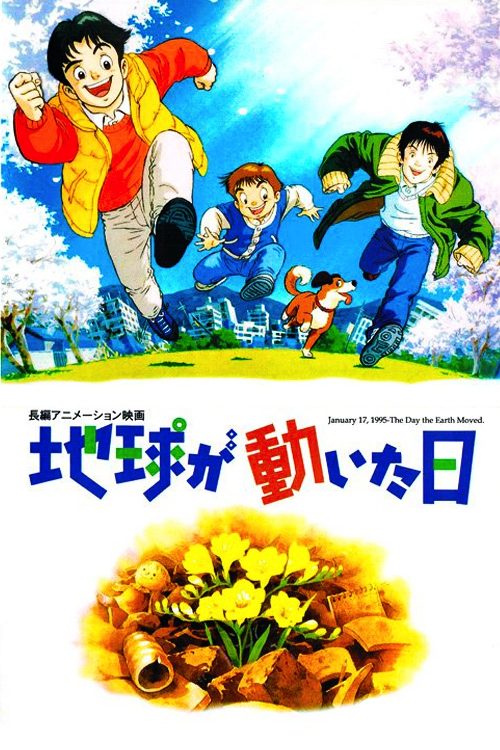
About The Day the Earth Moved
January 16, 1995. Tsuyoshi Takahashi, a young student at Shiokaze elementary, is driven solely to get excellent grades. Because of this he often ignores those around him in his pursuit of perfection. Miho, a young girl in his class that wishes he would appreciate the people around him. Kazu a sickly and bed ridden classmate that lives near him. January 17, the 1995 Kobe / Hyogoken-Nanbu Earthquake strikes killing more than 6000 people and leaving 300 000 more homeless. Measuring 6.9 on the Richter Scale, it was the largest Earthquake to hit Japan since the Great Kanto Earthquake of 1923. In the aftermath of the quake, Tsuyoshi's finds his priorities changing. Dealing with the death of one friend while helping another to cope with a very personal loss, Tsuyoshi is forced to mature into someone who can no longer ignore the suffering around him.
Few cinematic experiences capture the fragility of childhood innocence quite like the 1997 animated drama The Day the Earth Moved, a poignant reflection on the 1995 Great Hanshin Earthquake. Directed by Toshio Goto, the film shifts the lens away from the standard disaster movie spectacle, choosing instead to focus on the quiet, internal shifts of a young student named Tsuyoshi. While many films of the nineties relied on grand visual effects to depict catastrophe, this Japanese production utilizes the medium of animation to illustrate the emotional fissures left behind in a community when the ground suddenly gives way. For audiences accustomed to the high-octane emotional beats of contemporary Indian cinema, where social crises are often woven into larger-than-life narratives, this film offers a starkly different, meditative pace that prioritizes human connection over plot-driven tension.
The narrative centers on a protagonist whose singular obsession with academic achievement initially isolates him from his peers. By positioning Tsuyoshi as a boy defined by his grades rather than his empathy, the film creates a compelling arc that forces him to confront the limitations of his self-imposed bubble. When the seismic event occurs, the tragedy acts as a catalyst for a profound psychological transition. Rather than focusing on the mechanics of the rescue effort, the story dwells on the evolving dynamics between Tsuyoshi, a classmate who advocates for a more compassionate worldview, and a bedridden friend whose vulnerability highlights the sudden cruelty of fate. It is this intimacy that distinguishes the work, moving it firmly into the realm of character study rather than historical documentation.
Viewers who appreciate the understated, humanistic storytelling found in modern Malayalam classics will likely find much to admire in this project. It is tailor-made for those who prefer stories that examine the heavy burden of growing up amidst trauma and the necessity of looking beyond one’s own ambitions to see the suffering of others. Toshio Goto manages to transform a devastating real-world tragedy into an accessible lesson on maturity and social responsibility. By stripping away the sensationalism often associated with historical disasters, the film remains a deeply affecting piece of animation that asks a timeless question about what truly matters when the structures of our daily lives collapse. It serves as a somber yet essential reminder that the most significant transformations often occur not when the earth moves, but when we finally choose to open our eyes to the people standing right beside us.