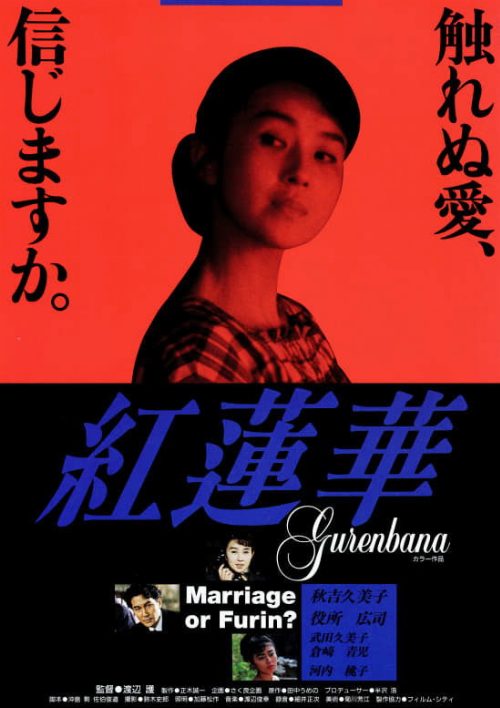
About Crimson Lotus
Sakura and Kenzo are married. Both think they can live a happy marriage, despite the fact that she cannot have children and he does not want to give up her relationship with her lover Yoko.
The 1993 Japanese drama Crimson Lotus offers a piercing examination of domestic instability, capturing the quiet decay of a relationship built on unspoken compromises. Directed by Mamoru Watanabe, the film navigates the turbulent emotional landscape of Sakura and Kenzo, a couple whose marriage is anchored by a fundamental fracture. While many domestic dramas of the era focused on the outward performance of harmony, this narrative dives deep into the internal contradictions of its leads, specifically addressing the pain of infertility and the complex reality of a partner maintaining a secondary romance. It stands out in the early nineties landscape for its refusal to provide easy moral judgments, instead allowing the audience to witness the slow erosion of intimacy within the confines of a traditional household.
For viewers familiar with the rich heritage of Indian regional cinema, particularly the emotionally taxing family sagas often found in Malayalam or Tamil parallel cinema, Crimson Lotus will feel surprisingly resonant. It echoes the themes of marital entrapment and personal autonomy that directors like Adoor Gopalakrishnan or K. Balachander explored with such clinical precision. The film functions as a character study, placing the weight of the drama on the shoulders of Koji Yakusho and Momoko Kochi. Yakusho, whose career eventually spanned internationally acclaimed roles, brings a grounded vulnerability to the husband, while Kochi delivers a performance that demands empathy even when the character choices are self-destructive. It is a work for those who appreciate slow-burning storytelling where the tension arises not from sudden plot twists, but from the crushing weight of daily routine and long-buried resentments.
By positioning the narrative within the specific cultural constraints of Japan at the time, Watanabe creates a microcosm of societal expectation versus individual desire. The film serves as a poignant reminder that the most profound conflicts often take place behind closed doors, away from the public gaze. It is not a film meant for those seeking escapist entertainment, but rather for the dedicated cinephile interested in how human desire persists even when the structures designed to contain it have begun to fail. The atmospheric direction and the deliberate pacing ensure that the psychological stakes feel authentic, making it a compelling piece of world cinema that invites the viewer to reflect on the fragility of human connections and the complex nature of forgiveness within the marital bond.