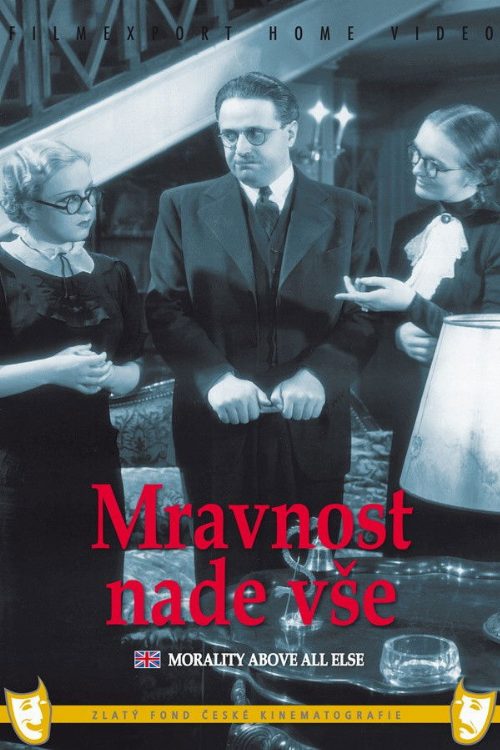
Morality Above All Else(1937)
About Morality Above All Else
Professor Karas is widely known as enthusiastic propagator of the motto "Morality Above All Else". He guides his students as well as his own family to live a morally decent life. One day he has an unexpected visit. It's his illegitimate daughter Vera, who is proof of his thoughtless youth. Mr. Karas know that she can ruin his image, thus he decides to keep her a secret and asks her to leave. Instead of leaving she takes a position of a governess in his own family without letting him know. Mr. Karas realizes that he must reveal the truth sooner or later, but he doesn't have enough courage to do so. As he postpones it, he is more and more scared to come to his own home.
At a time when the silver screen was dominated by earnest dramas and historical epics, the 1937 Czech production Morality Above All Else carved out a unique space by poking fun at the fragility of social respectability. This witty comedy centers on Professor Karas, a man whose public identity is built entirely upon a pedestal of rigid ethical standards and family values. The irony of the narrative kicks into high gear when his past arrives on his doorstep in the form of a daughter from a long-forgotten indiscretion. Rather than confronting his history with the intellectual honesty he preaches, the professor chooses the path of cowardice, spiraling into a comedic web of deceit that forces him to treat his own child as an outsider within his household.
The film serves as a fascinating relic of European cinema from the late thirties, capturing a societal obsession with outward appearances that feels surprisingly relevant today. For viewers who enjoy the sharp, dialogue-driven humor found in classic screwball comedies or the character-focused ironies prevalent in modern satire, this film offers a masterclass in tension. Hugo Haas leads the ensemble with a performance that balances the professor’s pomposity with a palpable sense of anxiety, ensuring that the audience laughs at his predicament rather than feeling pure contempt for his actions. The script cleverly avoids becoming a heavy-handed morality play, opting instead to highlight how easily a life built on a foundation of perfection can crumble when confronted with the messy reality of human connection.
While audiences accustomed to the high-octane energy of contemporary Indian cinema might find the pacing of this 1930s feature distinct, the underlying theme of the hidden family secret is a narrative trope that resonates across all cultures. Just as we see in many celebrated dramas from the Telugu or Hindi film industries where the weight of legacy and reputation drives the plot, this Czech gem explores the heavy cost of maintaining a flawless public image. It is an ideal pick for cinephiles who appreciate historical context and the evolution of the comedy genre. By turning a man of high standing into a nervous wreck, the film effectively strips away the mask of status to reveal the universal fears hiding underneath. It remains a polished, intelligent, and thoroughly amusing look at why honesty is usually the best policy, especially when one is trying to uphold a reputation for virtue.
Cast(16)