
About The Gift to Stalin
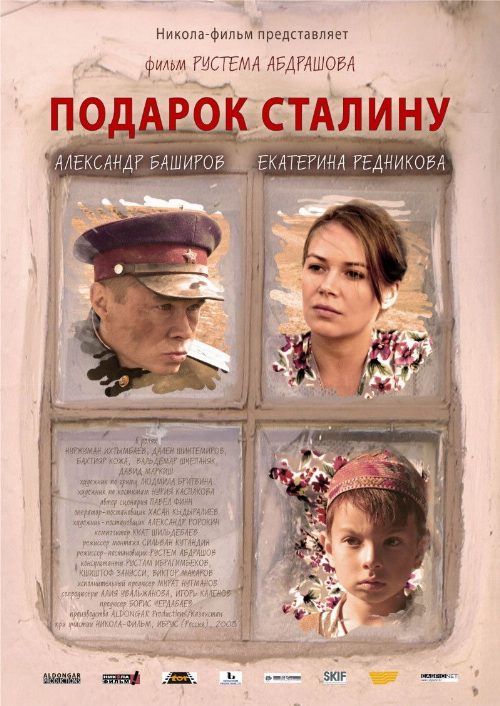
A Jewish child deported to Kazakhstan is saved and adopted by Kasym, an old Kazakh railway-man. Kasym gives him a Kazakh name, Sabyr, that in Kazakh language means humble. The child grows up in the small Kazakh village along with other deportees Vera, a traitor's wife, and Ezhik a Polish doctor. The Soviet militia harasses the poor peasants and Vera suffered the harassment of a bully cop: Bulgabi. Finally Vera accepts the marriage proposal of Ezhik but the jealous Bulgabi tries to prevent the marriage. The result is a fight in which Ezhik shoots himself accidentally. The old Kasym decides that Sabyr is now old enough to go to seek his real parents. At the end Sabyr, now an adult, decides to return to the village, but the village no longer exists because it was destroyed by a Soviet nuclear test.
Few cinematic experiences capture the stark intersection of historical tragedy and human endurance as poignantly as The Gift to Stalin. Set against the backdrop of the mid-twentieth-century Soviet deportations, the film examines the forced migration of diverse populations into the remote Kazakh steppe. While many historical dramas rely on grand spectacles to depict systemic oppression, this film chooses the path of intimacy, focusing on the quiet, daily resilience of a small village community. By centering the narrative on the bond between a displaced Jewish boy and a solitary railway worker, it highlights the universal language of empathy that transcends political borders, offering a narrative that resonates deeply with audiences who appreciate the slow-burn emotional power found in the best of parallel cinema.
The cultural significance of this production lies in its honest portrayal of the Kazakh landscape as a crucible for survival. In an era where global audiences are increasingly discovering the richness of regional storytelling, this film serves as a vital bridge to understanding the complex social dynamics of the Soviet era from a distinctly Central Asian perspective. The film is positioned as a character-driven drama that avoids the trap of excessive melodrama, instead leaning into the harsh beauty of its setting to reflect the internal states of its protagonists. For viewers who follow the evolution of non-mainstream cinema, the film offers a masterclass in atmospheric storytelling, where the environment itself acts as a silent witness to the trauma and healing of those living on the fringes of an empire.
Those who gravitate toward poignant, character-focused dramas will find much to admire in the nuanced performances and the director's restrained approach to a heavy subject matter. The strength of the film lies in its ability to balance the weight of historical context with the delicate, personal journey of a child finding a sense of belonging in an unforgiving climate. It avoids easy answers, opting instead to explore the complexities of identity and the lasting impact of displacement. As a piece of world cinema, it stands as a testament to the idea that even in the face of monumental historical erasure, the connections formed between individuals remain the most enduring legacy of the human experience. It is a contemplative watch that invites the viewer to reflect on the nature of home and the sacrifices made to protect the future of the next generation.
Cast(12)